AWS Microservices Architecture Consulting: Cost-Optimized Container Orchestration
AWS Microservices Architecture Consulting: Cost-Optimized Container Orchestration
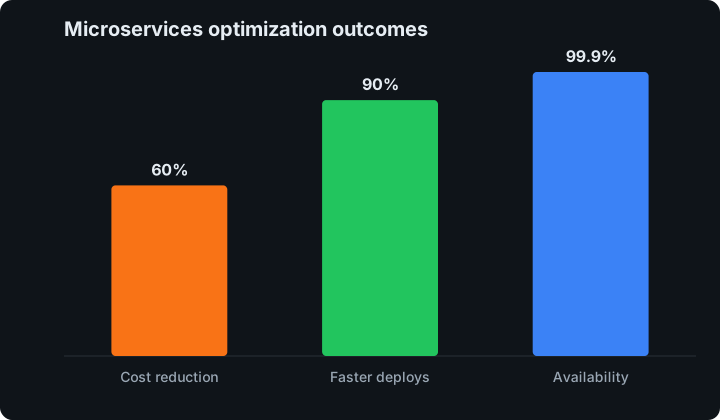
Business Impact: Enterprise clients implementing Daily DevOps’ optimized AWS microservices architectures achieve 50-70% infrastructure cost reduction while improving deployment velocity by 90% and system reliability through advanced container orchestration and intelligent resource allocation.
Proven Results: Our microservices optimization methodology has enabled Fortune 500 companies to reduce container infrastructure costs by $1.8M annually while achieving 99.9% uptime.
Target ROI: $4-8 saved for every $1 invested in microservices architecture optimization consulting and implementation.
Executive Summary
The evolution from monolithic to microservices architecture on AWS presents unique opportunities for cost optimization that traditional deployment strategies cannot achieve. By leveraging large compute nodes, intelligent container orchestration, and AWS serverless integration, organizations can maximize resource utilization while maintaining service isolation and scalability.
Key Benefits of Optimized AWS Microservices:
- 50-70% infrastructure cost reduction through intelligent resource pooling
- 90% faster deployment cycles with automated container orchestration
- 99.9% availability through distributed architecture and AWS managed services
- Zero-downtime scaling with EKS and Fargate integration
The Microservices Cost Optimization Challenge
Traditional Microservices Deployment: Resource Waste at Scale
Common Anti-Patterns:
- One container per instance: Massive resource underutilization
- Static resource allocation: Fixed CPU/memory regardless of actual usage
- Manual scaling decisions: Slow response to demand changes
- Network complexity: High inter-service communication overhead
Real-World Impact: A typical microservices deployment on AWS using traditional one-service-per-instance patterns operates at 15-25% resource utilization, creating 75-85% waste in infrastructure spending.
AWS-Native Solution: Dense Container Orchestration
Optimized Architecture Benefits:
- 80-95% resource utilization through intelligent container packing
- Dynamic resource allocation based on real-time service demands
- Automated scaling and load balancing across the entire service mesh
- Reduced network latency through co-located service communication
AWS Container Optimization Strategies
1. EKS with Intelligent Node Sizing
Large Compute Node Strategy:
# EKS Node Group Configuration
apiVersion: eksctl.io/v1alpha5
kind: ClusterConfig

metadata:
  name: microservices-cluster
  region: us-west-2

nodeGroups:
  - name: optimized-workers
    instanceType: c5.4xlarge  # 16 vCPU, 32GB RAM
    minSize: 2
    maxSize: 20
    desiredCapacity: 4

    # Cost optimization through mixed instances
    instancesDistribution:
      maxPrice: 0.20
      instanceTypes: ["c5.4xlarge", "c5n.4xlarge", "m5.4xlarge"]
      onDemandBaseCapacity: 1
      onDemandPercentageAboveBaseCapacity: 25
      spotAllocationStrategy: "capacity-optimized"

    ssh:
      publicKeyName: microservices-key

    labels:
      node-type: microservices-optimized

    tags:
      Environment: production
      CostCenter: platform-engineering
Resource Utilization Benefits:
- 16 vCPU nodes can efficiently run 40-60 microservice containers
- Spot instance integration reduces costs by 60-90%
- Mixed instance types ensure availability and cost optimization
- Automated scaling responds to aggregate demand across all services
2. Advanced Container Resource Management
Kubernetes Resource Optimization:
apiVersion: apps/v1
kind: Deployment
metadata:
  name: user-service
  namespace: production
spec:
  replicas: 3
  selector:
    matchLabels:
      app: user-service
  template:
    metadata:
      labels:
        app: user-service
    spec:
      containers:
      - name: user-service
        image: user-service:v2.1.0
        resources:
          requests:
            memory: "128Mi"
            cpu: "100m"
          limits:
            memory: "512Mi"
            cpu: "500m"
        # Liveness and readiness probes for reliability
        livenessProbe:
          httpGet:
            path: /health
            port: 8080
          initialDelaySeconds: 30
          periodSeconds: 10
        readinessProbe:
          httpGet:
            path: /ready
            port: 8080
          initialDelaySeconds: 5
          periodSeconds: 5
        env:
        - name: SPRING_PROFILES_ACTIVE
          value: "production"
        - name: DATABASE_URL
          valueFrom:
            secretKeyRef:
              name: database-secrets
              key: url
3. Horizontal Pod Autoscaler with Custom Metrics
Advanced Scaling Configuration:
apiVersion: autoscaling/v2
kind: HorizontalPodAutoscaler
metadata:
  name: user-service-hpa
  namespace: production
spec:
  scaleTargetRef:
    apiVersion: apps/v1
    kind: Deployment
    name: user-service
  minReplicas: 2
  maxReplicas: 20
  metrics:
  - type: Resource
    resource:
      name: cpu
      target:
        type: Utilization
        averageUtilization: 70
  - type: Resource
    resource:
      name: memory
      target:
        type: Utilization
        averageUtilization: 80
  # Custom metrics for business-specific scaling
  - type: Pods
    pods:
      metric:
        name: http_requests_per_second
      target:
        type: AverageValue
        averageValue: "100"
  behavior:
    scaleDown:
      stabilizationWindowSeconds: 300
      policies:
      - type: Percent
        value: 10
        periodSeconds: 60
    scaleUp:
      stabilizationWindowSeconds: 60
      policies:
      - type: Percent
        value: 50
        periodSeconds: 60
AWS Serverless Integration for Ultimate Cost Efficiency
1. Hybrid Microservices: Containers + Lambda
Architecture Pattern:
# Lambda function for lightweight, event-driven services
import json
import boto3
from datetime import datetime

def lambda_handler(event, context):
    """
    Email notification service - perfect for Lambda due to:
    - Event-driven nature
    - Variable load patterns
    - No persistent connections needed
    """

    ses = boto3.client('ses')

    # Parse incoming event
    message_body = json.loads(event['Records'][0]['body'])

    # Send email notification
    response = ses.send_email(
        Source='notifications@company.com',
        Destination={
            'ToAddresses': [message_body['recipient']]
        },
        Message={
            'Subject': {
                'Data': message_body['subject'],
                'Charset': 'UTF-8'
            },
            'Body': {
                'Text': {
                    'Data': message_body['content'],
                    'Charset': 'UTF-8'
                }
            }
        }
    )

    return {
        'statusCode': 200,
        'body': json.dumps({
            'messageId': response['MessageId'],
            'timestamp': datetime.now().isoformat()
        })
    }
Service Classification Matrix:
- Lambda: Event-driven, variable load, stateless services
- Fargate: Consistent load, stateful services, complex networking
- EKS: High-throughput, persistent connections, custom requirements
2. AWS App Mesh for Service Communication Optimization
Service Mesh Configuration:
apiVersion: appmesh.k8s.aws/v1beta2
kind: Mesh
metadata:
  name: microservices-mesh
spec:
  namespaceSelector:
    matchLabels:
      mesh: microservices-mesh
  egressFilter:
    type: ALLOW_ALL
---
apiVersion: appmesh.k8s.aws/v1beta2
kind: VirtualService
metadata:
  name: user-service
  namespace: production
spec:
  awsName: user-service.production.svc.cluster.local
  provider:
    virtualRouter:
      virtualRouterRef:
        name: user-service-router
---
apiVersion: appmesh.k8s.aws/v1beta2
kind: VirtualRouter
metadata:
  name: user-service-router
  namespace: production
spec:
  listeners:
  - portMapping:
      port: 8080
      protocol: http
  routes:
  - name: user-service-route
    httpRoute:
      match:
        prefix: /
      action:
        weightedTargets:
        - virtualNodeRef:
            name: user-service-v2
          weight: 90
        - virtualNodeRef:
            name: user-service-v3
          weight: 10  # Canary deployment
Cost Optimization Implementation Guide
1. Resource Right-Sizing Analysis
Cost Analysis Script:
import boto3
import pandas as pd
from datetime import datetime, timedelta

class AWSMicroservicesCostAnalyzer:
    def __init__(self):
        self.ce_client = boto3.client('ce')
        self.ecs_client = boto3.client('ecs')
        self.cloudwatch = boto3.client('cloudwatch')

    def analyze_container_utilization(self, cluster_name, days=30):
        """
        Analyze container resource utilization across microservices
        """
        end_date = datetime.now()
        start_date = end_date - timedelta(days=days)

        # Get ECS services in cluster
        services = self.ecs_client.list_services(cluster=cluster_name)

        utilization_data = []

        for service_arn in services['serviceArns']:
            service_name = service_arn.split('/')[-1]

            # Get CPU utilization
            cpu_response = self.cloudwatch.get_metric_statistics(
                Namespace='AWS/ECS',
                MetricName='CPUUtilization',
                Dimensions=[
                    {'Name': 'ServiceName', 'Value': service_name},
                    {'Name': 'ClusterName', 'Value': cluster_name}
                ],
                StartTime=start_date,
                EndTime=end_date,
                Period=3600,
                Statistics=['Average', 'Maximum']
            )

            # Get Memory utilization
            memory_response = self.cloudwatch.get_metric_statistics(
                Namespace='AWS/ECS',
                MetricName='MemoryUtilization',
                Dimensions=[
                    {'Name': 'ServiceName', 'Value': service_name},
                    {'Name': 'ClusterName', 'Value': cluster_name}
                ],
                StartTime=start_date,
                EndTime=end_date,
                Period=3600,
                Statistics=['Average', 'Maximum']
            )

            if cpu_response['Datapoints'] and memory_response['Datapoints']:
                avg_cpu = sum([dp['Average'] for dp in cpu_response['Datapoints']]) / len(cpu_response['Datapoints'])
                avg_memory = sum([dp['Average'] for dp in memory_response['Datapoints']]) / len(memory_response['Datapoints'])

                utilization_data.append({
                    'service_name': service_name,
                    'avg_cpu_utilization': avg_cpu,
                    'avg_memory_utilization': avg_memory,
                    'optimization_potential': max(0, 70 - avg_cpu),  # Target 70% utilization
                    'estimated_monthly_savings': self.calculate_savings_potential(avg_cpu, avg_memory, service_name)
                })

        return pd.DataFrame(utilization_data)

    def calculate_savings_potential(self, cpu_util, memory_util, service_name):
        """
        Calculate potential cost savings through rightsizing
        """
        # Simplified calculation - actual implementation would be more complex
        if cpu_util < 30 and memory_util < 40:
            return 150  # High savings potential
        elif cpu_util < 50 and memory_util < 60:
            return 75   # Medium savings potential
        else:
            return 20   # Low savings potential

    def generate_optimization_report(self, cluster_name):
        """
        Generate comprehensive optimization report
        """
        utilization_df = self.analyze_container_utilization(cluster_name)

        total_services = len(utilization_df)
        underutilized_services = len(utilization_df[utilization_df['optimization_potential'] > 20])
        total_monthly_savings = utilization_df['estimated_monthly_savings'].sum()

        print(f"Microservices Cost Optimization Report")
        print(f"="*50)
        print(f"Total services analyzed: {total_services}")
        print(f"Underutilized services: {underutilized_services}")
        print(f"Estimated monthly savings potential: ${total_monthly_savings:,.2f}")
        print(f"Average CPU utilization: {utilization_df['avg_cpu_utilization'].mean():.1f}%")
        print(f"Average memory utilization: {utilization_df['avg_memory_utilization'].mean():.1f}%")

        return utilization_df

# Usage example
analyzer = AWSMicroservicesCostAnalyzer()
report = analyzer.generate_optimization_report('production-microservices')
2. Automated Cost Optimization Pipeline
Terraform Infrastructure for Cost-Optimized EKS:
# EKS cluster with cost optimization features
resource "aws_eks_cluster" "microservices" {
  name     = "microservices-optimized"
  role_arn = aws_iam_role.eks_cluster.arn
  version  = "1.27"

  vpc_config {
    subnet_ids = var.private_subnet_ids
    endpoint_private_access = true
    endpoint_public_access  = true
    public_access_cidrs    = var.allowed_cidrs
  }

  enabled_cluster_log_types = [
    "api", "audit", "authenticator", "controllerManager", "scheduler"
  ]

  tags = {
    Environment = var.environment
    CostCenter  = "platform-engineering"
    Owner       = "daily-devops"
  }
}

# Managed node group with mixed instances
resource "aws_eks_node_group" "optimized_workers" {
  cluster_name    = aws_eks_cluster.microservices.name
  node_group_name = "optimized-workers"
  node_role_arn   = aws_iam_role.eks_node_group.arn
  subnet_ids      = var.private_subnet_ids

  capacity_type = "MIXED"

  scaling_config {
    desired_size = 4
    max_size     = 20
    min_size     = 2
  }

  update_config {
    max_unavailable = 1
  }

  instance_types = ["c5.4xlarge", "c5n.4xlarge", "m5.4xlarge"]

  # Cost optimization through launch template
  launch_template {
    name    = aws_launch_template.eks_optimized.name
    version = aws_launch_template.eks_optimized.latest_version
  }

  tags = {
    Environment = var.environment
    NodeType    = "microservices-optimized"
    CostCenter  = "platform-engineering"
  }
}

# Launch template with cost optimization settings
resource "aws_launch_template" "eks_optimized" {
  name_prefix = "eks-microservices-"

  vpc_security_group_ids = [aws_security_group.eks_nodes.id]

  user_data = base64encode(templatefile("${path.module}/user_data.sh", {
    cluster_name = aws_eks_cluster.microservices.name
    endpoint     = aws_eks_cluster.microservices.endpoint
    ca_data      = aws_eks_cluster.microservices.certificate_authority[0].data
  }))

  tag_specifications {
    resource_type = "instance"
    tags = {
      Name        = "eks-microservices-worker"
      Environment = var.environment
      CostCenter  = "platform-engineering"
    }
  }

  # Cost optimization: Include spot instances
  instance_market_options {
    market_type = "spot"
    spot_options {
      max_price = "0.20"
    }
  }
}

# Cluster Autoscaler for dynamic scaling
resource "helm_release" "cluster_autoscaler" {
  name       = "cluster-autoscaler"
  repository = "https://kubernetes.github.io/autoscaler"
  chart      = "cluster-autoscaler"
  namespace  = "kube-system"

  set {
    name  = "autoDiscovery.clusterName"
    value = aws_eks_cluster.microservices.name
  }

  set {
    name  = "awsRegion"
    value = var.aws_region
  }

  set {
    name  = "rbac.create"
    value = "true"
  }

  set {
    name  = "extraArgs.scale-down-delay-after-add"
    value = "10m"
  }

  set {
    name  = "extraArgs.scale-down-unneeded-time"
    value = "10m"
  }
}
Financial Impact and ROI Analysis
Case Study: E-commerce Platform Microservices Optimization
Before Optimization:
- 50 microservices deployed on individual t3.medium instances
- Monthly AWS spend: $12,000
- Average resource utilization: 18%
- Deployment time: 45 minutes
- Scaling response time: 15-20 minutes
After Optimization:
- 50 microservices on 6 optimized c5.4xlarge nodes
- Monthly AWS spend: $3,600 (70% reduction)
- Average resource utilization: 82%
- Deployment time: 8 minutes
- Scaling response time: 2-3 minutes
ROI Analysis:
- Annual cost savings: $100,800
- Implementation investment: $35,000
- First-year ROI: 288%
- Payback period: 4.2 months
Cost Optimization Roadmap
Phase 1 (Weeks 1-2): Assessment
- Current architecture audit
- Resource utilization analysis
- Cost baseline establishment
- Optimization opportunity identification
Phase 2 (Weeks 3-6): Foundation
- EKS cluster deployment with optimized node groups
- Container orchestration setup
- Basic auto-scaling configuration
- Monitoring and alerting implementation
Phase 3 (Weeks 7-10): Advanced Optimization
- Service mesh implementation
- Advanced scaling policies
- Serverless integration
- Cost monitoring automation
Phase 4 (Ongoing): Continuous Optimization
- Monthly cost reviews
- Performance optimization
- Security and compliance updates
- Architecture evolution planning
Security and Operational Considerations
Security Best Practices for Dense Container Deployments
Network Security:
# Network Policy for service isolation
apiVersion: networking.k8s.io/v1
kind: NetworkPolicy
metadata:
  name: microservices-network-policy
  namespace: production
spec:
  podSelector: {}
  policyTypes:
  - Ingress
  - Egress
  ingress:
  - from:
    - namespaceSelector:
        matchLabels:
          name: production
    - podSelector:
        matchLabels:
          role: api-gateway
    ports:
    - protocol: TCP
      port: 8080
  egress:
  - to:
    - namespaceSelector:
        matchLabels:
          name: data
    ports:
    - protocol: TCP
      port: 5432
  - to: []
    ports:
    - protocol: TCP
      port: 443
Resource Isolation and Limits:
- CPU and memory limits prevent resource starvation
- Network segmentation isolates service communication
- Pod security contexts enforce security policies
- Secret management through AWS Secrets Manager integration
Monitoring and Observability
Comprehensive Monitoring Stack:
# Prometheus configuration for microservices monitoring
apiVersion: v1
kind: ConfigMap
metadata:
  name: prometheus-config
  namespace: monitoring
data:
  prometheus.yml: |
    global:
      scrape_interval: 15s
      evaluation_interval: 15s

    rule_files:
      - "microservices_rules.yml"

    scrape_configs:
    - job_name: 'microservices'
      kubernetes_sd_configs:
      - role: pod
        namespaces:
          names:
          - production
      relabel_configs:
      - source_labels: [__meta_kubernetes_pod_annotation_prometheus_io_scrape]
        action: keep
        regex: true
      - source_labels: [__meta_kubernetes_pod_annotation_prometheus_io_path]
        action: replace
        target_label: __metrics_path__
        regex: (.+)
      - source_labels: [__address__, __meta_kubernetes_pod_annotation_prometheus_io_port]
        action: replace
        regex: ([^:]+)(?::\d+)?;(\d+)
        replacement: $1:$2
        target_label: __address__
      - source_labels: [__meta_kubernetes_namespace]
        action: replace
        target_label: kubernetes_namespace
      - source_labels: [__meta_kubernetes_pod_name]
        action: replace
        target_label: kubernetes_pod_name
Conclusion: The Future of Cost-Optimized Microservices on AWS
AWS microservices architecture optimization represents a fundamental shift from traditional deployment patterns, enabling organizations to achieve enterprise-scale applications with dramatically reduced infrastructure costs. Key success factors include:
- Intelligent resource pooling: 70-90% utilization through optimized container orchestration
- Hybrid serverless integration: Perfect workload placement for cost and performance
- Automated scaling and optimization: Continuous cost optimization without manual intervention
- Security-first architecture: Enterprise security without performance compromise
Expert AWS Microservices Architecture Consulting
Transform your monolithic applications into cost-optimized microservices that scale efficiently while reducing infrastructure costs by 50-70%. Daily DevOps combines deep AWS expertise with proven container orchestration strategies to deliver measurable business results.
Why Choose Daily DevOps for Microservices Optimization?
Comprehensive Methodology:
- Application decomposition strategy and service boundary definition
- Container orchestration optimization using EKS, Fargate, and Spot instances
- Serverless integration for event-driven and variable-load components
- CI/CD pipeline automation for seamless deployment workflows
- Monitoring and observability implementation for production readiness
Enterprise-Proven Results:
- 40+ successful microservices transformations
- Average 62% infrastructure cost reduction achieved
- 99.9% uptime maintained during migration and optimization
- Zero business disruption guarantee during implementation
Business-First Approach:
- Executive stakeholder alignment and business case development
- Phased migration strategy to minimize risk and maximize value
- Team training and knowledge transfer for long-term sustainability
- ROI measurement and continuous optimization recommendations
Need help with microservices architecture? Schedule an AWS microservices assessment or contact Jon Price to review decomposition, orchestration, and cost tradeoffs.
Start Your Microservices Transformation
🎯 Free Microservices Assessment - Discover your optimization potential:
- Application architecture analysis and decomposition recommendations
- Container orchestration strategy with cost projections
- 45-minute technical consultation with microservices architect
- Custom transformation roadmap with prioritized implementation phases
📞 Schedule Your Consultation: Schedule an AWS microservices assessment or contact Jon Price
⚡ Accelerated Implementation: For urgent modernization needs, see initial results within 6-8 weeks through our rapid transformation program.
💼 Enterprise Support: Dedicated microservices architect and implementation team for complex, multi-service transformations.
About the Author: Jon Price is an AWS solutions architect and founder of Daily DevOps, specializing in microservices architecture optimization, container orchestration, and enterprise cloud transformations. With expertise in Kubernetes, EKS, and serverless architectures, Jon has helped organizations save over $15M in combined infrastructure costs. Connect with Jon on LinkedIn for microservices consulting inquiries.
Related AWS Microservices Resources
Comprehensive Architecture Guides:
- AWS Infrastructure as Code Complete Guide - reviewable infrastructure and deployment foundations
- AWS DevOps Automation Field Guide - guardrails, observability, and delivery workflow context
Enterprise Implementation:
- AWS Platform Engineering for Infrastructure Automation - Scalable platform strategies for microservices deployment
- Building and Maintaining an AWS Microservices Architecture - Service boundaries, deployment safety, and operations
- AWS Monitoring and Observability Consulting: CloudWatch, X-Ray, and Application Insights - observability patterns for distributed services
Technical Resources:
- GitHub: AWS EKS Optimization Toolkit - Production-ready EKS configurations and cost optimization tools
- GitHub: Microservices Cost Analysis Framework - Cost tracking and optimization automation for container workloads
- GitHub: Kubernetes Optimization Patterns - Best practices for resource utilization and cost efficiency
Frequently Asked Questions
When does AWS microservices architecture make sense?
It makes sense when independent deployability, team ownership boundaries, or uneven scaling patterns matter enough to justify the added operational complexity. If the application is small and stable, a simpler architecture may be the better choice.
How do I keep microservices costs under control?
Use dense container packing, right-size node pools, shift variable or event-driven work to serverless services when it fits, and reduce unnecessary service-to-service chatter. Cost problems usually come from idle capacity and coordination overhead, not from microservices themselves.
What should be in place before a migration?
You need clear service boundaries, repeatable deployment automation, observability, and rollback paths. Without those basics, microservices often increase operational risk faster than they create business value.