AWS Serverless Security Implementation Guide for Enterprise Compliance
AWS Serverless Security Implementation: Complete Enterprise DevSecOps Framework
Serverless security works when controls are built into the delivery path instead of bolted on after deployment. Lambda functions, API Gateway endpoints, DynamoDB tables, S3 buckets, KMS keys, event buses, and monitoring rules all need explicit ownership, least-privilege access, encryption decisions, and observable failure modes.
This guide focuses on practical implementation patterns for AWS teams that need serverless velocity without losing security reviewability or compliance evidence.
2026 AWS Serverless Security Update
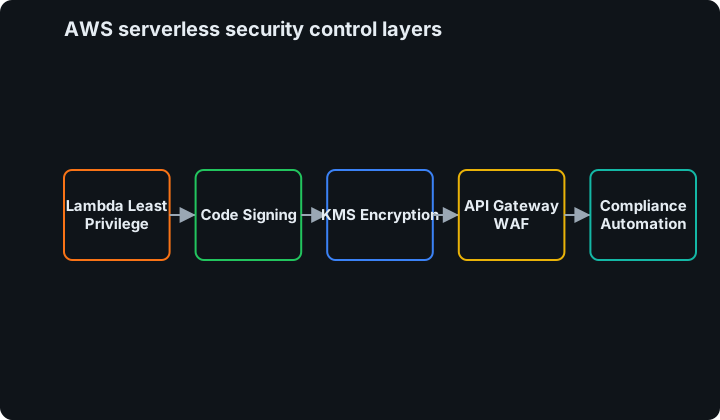
Current AWS serverless security programs should treat deployment integrity, workload identity, API perimeter controls, and encryption posture as first-class pipeline evidence:
- Lambda code signing verifies that new ZIP-package deployments are signed by a trusted source. AWS notes that validation happens during deployment, and code signing configurations define allowed signing profiles and the policy action for failed validation checks. Container image functions need a different integrity path because Lambda code signing does not support container images.
- IAM security best practices emphasize roles and temporary credentials for workloads. For Lambda, that means per-function execution roles, scoped resources, and permissions derived from actual API usage rather than broad shared roles.
- Lambda environment variable encryption is enabled at rest by default, and teams can configure customer managed KMS keys for tighter control. AWS also documents KMS options for environment variable encryption when sensitive configuration needs stronger key ownership.
- AWS WAF for API Gateway REST APIs helps protect API endpoints from common web exploits such as SQL injection and cross-site scripting. AWS Managed Rules for AWS WAF provide managed rule groups for common application vulnerabilities and unwanted traffic.
Related Daily DevOps guides:
- AWS security consulting DevSecOps implementation guide
- AWS multi-account security architecture
- AWS DevOps automation field guide
- DevSecOps pipeline templates repository
- Start a security automation conversation
Enterprise Serverless Security Architecture
Modern serverless applications require sophisticated security that addresses unique challenges including ephemeral compute, API-first architectures, and distributed data patterns. Enterprise serverless security must balance rapid development velocity with comprehensive threat protection and regulatory compliance.
Core Security Domains:
1. Compute Security (Lambda Functions)
- Runtime isolation and environment protection
- Least privilege IAM policies and resource-based access
- Code integrity verification and deployment security
- Memory and execution time security monitoring
2. API Security (API Gateway)
- Comprehensive API authentication and authorization
- Rate limiting, throttling, and DDoS protection
- Input validation and injection attack prevention
- API versioning and deprecation security
3. Data Security (DynamoDB, S3, RDS Proxy)
- Encryption at rest and in transit across all data stores
- Fine-grained access controls and data classification
- Data residency and cross-region replication security
- Backup encryption and disaster recovery protection
4. Network Security (VPC, PrivateLink)
- Network isolation and micro-segmentation
- Private API endpoints and secure service communication
- VPC flow logs and network monitoring
- DNS security and service discovery protection
Comprehensive Lambda Security Implementation
Advanced IAM Security Patterns
Least Privilege IAM Framework:
import boto3
import json
from typing import Dict, List, Any

class LambdaSecurityManager:
    def __init__(self):
        self.iam = boto3.client('iam')
        self.lambda_client = boto3.client('lambda')

    def create_least_privilege_role(self, function_name: str, required_services: List[str]):
        """Create minimal IAM role with only required permissions"""

        # Define base trust policy for Lambda
        trust_policy = {
            "Version": "2012-10-17",
            "Statement": [
                {
                    "Effect": "Allow",
                    "Principal": {
                        "Service": "lambda.amazonaws.com"
                    },
                    "Action": "sts:AssumeRole",
                    "Condition": {
                        "StringEquals": {
                            "aws:SourceAccount": self.get_account_id()
                        }
                    }
                }
            ]
        }

        # Generate minimal permission policy
        permission_policy = self.generate_minimal_permissions(function_name, required_services)

        role_name = f"{function_name}-execution-role"

        try:
            # Create IAM role
            role_response = self.iam.create_role(
                RoleName=role_name,
                AssumeRolePolicyDocument=json.dumps(trust_policy),
                Description=f"Minimal execution role for {function_name}",
                MaxSessionDuration=3600,
                Tags=[
                    {'Key': 'Function', 'Value': function_name},
                    {'Key': 'SecurityLevel', 'Value': 'LeastPrivilege'},
                    {'Key': 'ManagedBy', 'Value': 'DailyDevOps-Security'}
                ]
            )

            # Attach minimal policy
            self.iam.put_role_policy(
                RoleName=role_name,
                PolicyName=f"{function_name}-minimal-policy",
                PolicyDocument=json.dumps(permission_policy)
            )

            # Attach basic Lambda execution policy
            self.iam.attach_role_policy(
                RoleName=role_name,
                PolicyArn='arn:aws:iam::aws:policy/service-role/AWSLambdaBasicExecutionRole'
            )

            return role_response['Role']['Arn']

        except Exception as e:
            print(f"Error creating IAM role: {e}")
            return None

    def generate_minimal_permissions(self, function_name: str, required_services: List[str]) -> Dict[str, Any]:
        """Generate minimal IAM policy based on required services"""

        statements = []

        service_permissions = {
            'dynamodb': {
                'Effect': 'Allow',
                'Action': [
                    'dynamodb:GetItem',
                    'dynamodb:PutItem',
                    'dynamodb:UpdateItem',
                    'dynamodb:DeleteItem',
                    'dynamodb:Query',
                    'dynamodb:Scan'
                ],
                'Resource': [
                    f"arn:aws:dynamodb:*:*:table/{function_name}-*"
                ],
                'Condition': {
                    'ForAllValues:StringEquals': {
                        'dynamodb:Attributes': ['id', 'data', 'timestamp']
                    }
                }
            },
            's3': {
                'Effect': 'Allow',
                'Action': [
                    's3:GetObject',
                    's3:PutObject',
                    's3:DeleteObject'
                ],
                'Resource': [
                    f"arn:aws:s3:::{function_name}-bucket/*"
                ],
                'Condition': {
                    'StringEquals': {
                        's3:x-amz-server-side-encryption': 'AES256'
                    }
                }
            },
            'kms': {
                'Effect': 'Allow',
                'Action': [
                    'kms:Decrypt',
                    'kms:GenerateDataKey'
                ],
                'Resource': [
                    f"arn:aws:kms:*:*:key/*"
                ],
                'Condition': {
                    'StringEquals': {
                        'kms:ViaService': f"s3.us-east-1.amazonaws.com"
                    }
                }
            },
            'secretsmanager': {
                'Effect': 'Allow',
                'Action': [
                    'secretsmanager:GetSecretValue'
                ],
                'Resource': [
                    f"arn:aws:secretsmanager:*:*:secret:{function_name}/*"
                ]
            }
        }

        # Add only required service permissions
        for service in required_services:
            if service in service_permissions:
                statements.append(service_permissions[service])

        return {
            "Version": "2012-10-17",
            "Statement": statements
        }

    def implement_runtime_security(self, function_name: str):
        """Implement comprehensive runtime security controls"""

        security_config = {
            'Environment': {
                'Variables': {
                    'SECURITY_MODE': 'strict',
                    'LOG_LEVEL': 'INFO',
                    'ENCRYPTION_REQUIRED': 'true'
                }
            },
            'DeadLetterConfig': {
                'TargetArn': f"arn:aws:sqs:us-east-1:*:{function_name}-dlq"
            },
            'TracingConfig': {
                'Mode': 'Active'
            },
            'ReservedConcurrencyLimit': 100,  # Prevent resource exhaustion
            'KMSKeyArn': f"arn:aws:kms:*:*:key/*",  # Encrypt environment variables
            'Tags': {
                'SecurityCompliance': 'enterprise',
                'DataClassification': 'confidential',
                'MonitoringEnabled': 'true'
            }
        }

        try:
            self.lambda_client.update_function_configuration(
                FunctionName=function_name,
                **security_config
            )

            # Enable function-level monitoring
            self.setup_function_monitoring(function_name)

            return True

        except Exception as e:
            print(f"Error implementing runtime security: {e}")
            return False
Code Integrity and Deployment Security:
class SecureDeploymentManager:
    def __init__(self):
        self.lambda_client = boto3.client('lambda')
        self.signer = boto3.client('signer')

    def implement_code_signing(self, function_name: str, code_signing_config_arn: str):
        """Implement code signing for Lambda functions"""

        try:
            # Create signing profile if not exists
            signing_profile = self.create_signing_profile(function_name)

            # Update function to require signed code
            response = self.lambda_client.update_function_configuration(
                FunctionName=function_name,
                CodeSigningConfigArn=code_signing_config_arn
            )

            # Validate deployment integrity
            self.validate_deployment_integrity(function_name)

            return True

        except Exception as e:
            print(f"Error implementing code signing: {e}")
            return False

    def create_signing_profile(self, function_name: str):
        """Create AWS Signer profile for code signing"""

        profile_name = f"{function_name}-signing-profile"

        response = self.signer.put_signing_profile(
            profileName=profile_name,
            signingMaterial={
                'certificateArn': 'arn:aws:acm:us-east-1:*:certificate/*'
            },
            platformId='AWSLambda-SHA384-ECDSA',
            overrides={
                'signingConfiguration': {
                    'encryptionAlgorithm': 'ECDSA',
                    'hashAlgorithm': 'SHA384'
                }
            },
            signatureValidityPeriod={
                'value': 365,
                'type': 'DAYS'
            },
            tags={
                'Function': function_name,
                'SecurityLevel': 'Enterprise',
                'Purpose': 'CodeIntegrity'
            }
        )

        return response['arn']

    def implement_secure_deployment_pipeline(self):
        """Comprehensive secure deployment pipeline"""

        pipeline_template = '''
# Secure Lambda Deployment Pipeline
import hashlib
import boto3
import json
from typing import Dict, Any

class SecureLambdaDeployment:
    def __init__(self):
        self.lambda_client = boto3.client('lambda')
        self.s3 = boto3.client('s3')

    def secure_deploy(self, function_name: str, code_location: str,
                     security_config: Dict[str, Any]):
        """Deploy Lambda function with comprehensive security validation"""

        # Step 1: Validate code integrity
        code_hash = self.calculate_code_hash(code_location)
        self.verify_code_signature(code_location)

        # Step 2: Security configuration validation
        validated_config = self.validate_security_config(security_config)

        # Step 3: Deploy with monitoring
        deployment_result = self.deploy_with_monitoring(
            function_name, code_location, validated_config
        )

        # Step 4: Post-deployment security validation
        self.validate_post_deployment_security(function_name)

        return deployment_result

    def validate_security_config(self, config: Dict[str, Any]) -> Dict[str, Any]:
        """Validate and enhance security configuration"""

        required_security_settings = {
            'Environment': {
                'Variables': {
                    'SECURITY_MODE': 'strict',
                    'LOG_LEVEL': 'INFO'
                }
            },
            'TracingConfig': {'Mode': 'Active'},
            'DeadLetterConfig': {'TargetArn': 'arn:aws:sqs:*'},
            'ReservedConcurrencyLimit': 100
        }

        # Merge with provided config, security settings take precedence
        validated_config = {**config, **required_security_settings}

        # Validate IAM role has minimal permissions
        self.validate_iam_permissions(validated_config.get('Role'))

        return validated_config

    def deploy_with_monitoring(self, function_name: str, code_location: str,
                             config: Dict[str, Any]):
        """Deploy function with comprehensive monitoring setup"""

        try:
            # Deploy function
            response = self.lambda_client.update_function_code(
                FunctionName=function_name,
                S3Bucket=code_location['bucket'],
                S3Key=code_location['key'],
                S3ObjectVersion=code_location['version']
            )

            # Update configuration
            self.lambda_client.update_function_configuration(
                FunctionName=function_name,
                **config
            )

            # Setup security monitoring
            self.setup_security_monitoring(function_name)

            # Create security dashboard
            self.create_security_dashboard(function_name)

            return response

        except Exception as e:
            # Rollback on failure
            self.rollback_deployment(function_name)
            raise e
'''

        return pipeline_template
API Gateway Security Implementation
Comprehensive API Protection Framework
API Gateway Security Configuration:
# CloudFormation template for secure API Gateway
AWSTemplateFormatVersion: '2010-09-09'
Description: 'Daily DevOps Enterprise API Gateway Security Framework'

Parameters:
  Environment:
    Type: String
    AllowedValues: [development, staging, production]
    Default: production

  RateLimitPeriod:
    Type: Number
    Default: 10000
    Description: 'Rate limit requests per period'

Resources:
  SecureAPIGateway:
    Type: AWS::ApiGateway::RestApi
    Properties:
      Name: !Sub '${Environment}-secure-api'
      Description: 'Enterprise-secured API with comprehensive protection'
      EndpointConfiguration:
        Types:
          - REGIONAL
      Policy:
        Version: '2012-10-17'
        Statement:
          - Effect: Deny
            Principal: '*'
            Action: 'execute-api:Invoke'
            Resource: '*'
            Condition:
              StringNotEquals:
                'aws:SourceVpce': !Ref VPCEndpoint

  APIGatewayAccount:
    Type: AWS::ApiGateway::Account
    Properties:
      CloudWatchRoleArn: !GetAtt CloudWatchRole.Arn

  RequestValidator:
    Type: AWS::ApiGateway::RequestValidator
    Properties:
      RestApiId: !Ref SecureAPIGateway
      Name: 'comprehensive-validator'
      ValidateRequestBody: true
      ValidateRequestParameters: true

  SecurityModel:
    Type: AWS::ApiGateway::Model
    Properties:
      RestApiId: !Ref SecureAPIGateway
      Name: 'SecurityModel'
      ContentType: 'application/json'
      Schema:
        $schema: 'http://json-schema.org/draft-04/schema#'
        type: 'object'
        properties:
          userId:
            type: 'string'
            pattern: '^[a-zA-Z0-9_-]+$'
            minLength: 1
            maxLength: 128
          data:
            type: 'object'
            additionalProperties: false
        required:
          - userId
        additionalProperties: false

  ThrottlingPolicy:
    Type: AWS::ApiGateway::UsagePlan
    Properties:
      UsagePlanName: !Sub '${Environment}-throttling-policy'
      Description: 'Enterprise throttling and quota management'
      ApiStages:
        - ApiId: !Ref SecureAPIGateway
          Stage: !Ref APIStage
          Throttle:
            RateLimit: !Ref RateLimitPeriod
            BurstLimit: !Ref RateLimitPeriod
      Throttle:
        RateLimit: !Ref RateLimitPeriod
        BurstLimit: !Ref RateLimitPeriod
      Quota:
        Limit: 1000000
        Period: MONTH

  WAFWebACL:
    Type: AWS::WAFv2::WebACL
    Properties:
      Name: !Sub '${Environment}-api-waf'
      Scope: REGIONAL
      DefaultAction:
        Allow: {}
      Rules:
        - Name: 'AWS-AWSManagedRulesCommonRuleSet'
          Priority: 1
          Statement:
            ManagedRuleGroupStatement:
              VendorName: AWS
              Name: AWSManagedRulesCommonRuleSet
          OverrideAction:
            None: {}
          VisibilityConfig:
            SampledRequestsEnabled: true
            CloudWatchMetricsEnabled: true
            MetricName: 'CommonRuleSetMetric'
        - Name: 'AWS-AWSManagedRulesKnownBadInputsRuleSet'
          Priority: 2
          Statement:
            ManagedRuleGroupStatement:
              VendorName: AWS
              Name: AWSManagedRulesKnownBadInputsRuleSet
          OverrideAction:
            None: {}
          VisibilityConfig:
            SampledRequestsEnabled: true
            CloudWatchMetricsEnabled: true
            MetricName: 'BadInputsRuleSetMetric'
        - Name: 'RateLimitRule'
          Priority: 3
          Statement:
            RateBasedStatement:
              Limit: 2000
              AggregateKeyType: IP
          Action:
            Block: {}
          VisibilityConfig:
            SampledRequestsEnabled: true
            CloudWatchMetricsEnabled: true
            MetricName: 'RateLimitMetric'

  VPCEndpoint:
    Type: AWS::EC2::VPCEndpoint
    Properties:
      VpcId: !Ref VPC
      ServiceName: !Sub 'com.amazonaws.${AWS::Region}.execute-api'
      VpcEndpointType: Interface
      SubnetIds:
        - !Ref PrivateSubnet1
        - !Ref PrivateSubnet2
      SecurityGroupIds:
        - !Ref APISecurityGroup
      PolicyDocument:
        Version: '2012-10-17'
        Statement:
          - Effect: Allow
            Principal: '*'
            Action:
              - 'execute-api:Invoke'
            Resource: !Sub '${SecureAPIGateway}/*'
            Condition:
              StringEquals:
                'aws:PrincipalVpc': !Ref VPC
Advanced Authentication and Authorization:
import boto3
import jwt
import json
from datetime import datetime, timedelta
from typing import Dict, Any, Optional

class APISecurityManager:
    def __init__(self):
        self.cognito = boto3.client('cognito-idp')
        self.dynamodb = boto3.client('dynamodb')

    def implement_multi_layer_auth(self):
        """Implement comprehensive authentication and authorization"""

        auth_layers = {
            'api_key': self.validate_api_key,
            'jwt_token': self.validate_jwt_token,
            'resource_access': self.validate_resource_access,
            'rate_limiting': self.enforce_rate_limits,
            'security_headers': self.validate_security_headers
        }

        return auth_layers

    def create_secure_authorizer(self):
        """Create Lambda authorizer with comprehensive security validation"""

        authorizer_code = '''
import json
import jwt
import boto3
from datetime import datetime
import logging

logger = logging.getLogger()
logger.setLevel(logging.INFO)

def lambda_handler(event, context):
    """Comprehensive API Gateway authorizer with security validation"""

    try:
        # Extract authorization token
        token = event['authorizationToken']
        method_arn = event['methodArn']

        # Validate token format and structure
        if not token or not token.startswith('Bearer '):
            raise Exception('Invalid token format')

        # Extract JWT token
        jwt_token = token[7:]  # Remove 'Bearer ' prefix

        # Validate JWT token
        decoded_token = validate_jwt_token(jwt_token)

        # Extract user information
        user_id = decoded_token['sub']
        user_roles = decoded_token.get('custom:roles', [])

        # Validate user permissions for requested resource
        permissions = validate_user_permissions(user_id, method_arn, user_roles)

        # Create policy response
        policy = generate_policy(user_id, permissions['effect'], method_arn)

        # Add context for downstream Lambda functions
        policy['context'] = {
            'userId': user_id,
            'userRoles': ','.join(user_roles),
            'securityLevel': permissions['security_level'],
            'requestTime': str(datetime.utcnow()),
            'authValidated': 'true'
        }

        # Log successful authorization
        logger.info(f"Authorization successful for user {user_id}")

        return policy

    except Exception as e:
        logger.error(f"Authorization failed: {str(e)}")
        raise Exception('Unauthorized')

def validate_jwt_token(token):
    """Validate JWT token with comprehensive security checks"""

    try:
        # Get JWT signing key from parameter store
        ssm = boto3.client('ssm')
        jwt_secret = ssm.get_parameter(
            Name='/api/jwt-secret',
            WithDecryption=True
        )['Parameter']['Value']

        # Decode and validate token
        decoded = jwt.decode(
            token,
            jwt_secret,
            algorithms=['HS256'],
            options={
                'verify_signature': True,
                'verify_exp': True,
                'verify_iat': True,
                'verify_aud': True
            },
            audience='api.daily-devops.com'
        )

        # Additional security validations
        if not decoded.get('sub'):
            raise Exception('Token missing subject')

        if decoded.get('iss') != 'api.daily-devops.com':
            raise Exception('Invalid token issuer')

        return decoded

    except jwt.ExpiredSignatureError:
        raise Exception('Token expired')
    except jwt.InvalidTokenError:
        raise Exception('Invalid token')

def validate_user_permissions(user_id, method_arn, user_roles):
    """Validate user permissions for requested resource"""

    # Parse method ARN to extract resource information
    arn_parts = method_arn.split(':')
    api_gateway_arn = arn_parts[5]
    method_parts = api_gateway_arn.split('/')

    resource_path = '/'.join(method_parts[3:])
    http_method = method_parts[2]

    # Check resource-specific permissions
    dynamodb = boto3.client('dynamodb')

    response = dynamodb.get_item(
        TableName='user-permissions',
        Key={
            'userId': {'S': user_id},
            'resource': {'S': resource_path}
        }
    )

    if 'Item' not in response:
        return {'effect': 'Deny', 'security_level': 'none'}

    permissions = response['Item']
    allowed_methods = permissions.get('allowedMethods', {}).get('SS', [])

    if http_method not in allowed_methods:
        return {'effect': 'Deny', 'security_level': 'none'}

    # Validate role-based access
    required_roles = permissions.get('requiredRoles', {}).get('SS', [])
    if required_roles and not any(role in user_roles for role in required_roles):
        return {'effect': 'Deny', 'security_level': 'none'}

    return {
        'effect': 'Allow',
        'security_level': permissions.get('securityLevel', {}).get('S', 'standard')
    }

def generate_policy(principal_id, effect, resource):
    """Generate IAM policy for API Gateway"""

    return {
        'principalId': principal_id,
        'policyDocument': {
            'Version': '2012-10-17',
            'Statement': [
                {
                    'Action': 'execute-api:Invoke',
                    'Effect': effect,
                    'Resource': resource
                }
            ]
        }
    }
'''

        return authorizer_code

    def implement_api_security_monitoring(self):
        """Implement comprehensive API security monitoring"""

        monitoring_config = {
            'CloudWatch': {
                'metrics': [
                    'API Gateway 4XXError',
                    'API Gateway 5XXError',
                    'API Gateway Latency',
                    'API Gateway CacheHitCount',
                    'API Gateway CacheMissCount'
                ],
                'alarms': [
                    {
                        'name': 'High4XXErrors',
                        'threshold': 10,
                        'comparison': 'GreaterThanThreshold',
                        'period': 300
                    },
                    {
                        'name': 'High5XXErrors',
                        'threshold': 5,
                        'comparison': 'GreaterThanThreshold',
                        'period': 300
                    }
                ]
            },
            'WAF': {
                'blocked_requests_threshold': 100,
                'rate_limit_threshold': 2000,
                'monitoring_interval': 300
            },
            'X-Ray': {
                'tracing_enabled': True,
                'sampling_rate': 0.1,
                'service_map_enabled': True
            }
        }

        return monitoring_config
Data Security and Encryption Implementation
Comprehensive Data Protection Framework
DynamoDB Security Implementation:
import boto3
import json
from boto3.dynamodb.types import TypeDeserializer
from typing import Dict, Any, List

class DynamoDBSecurityManager:
    def __init__(self):
        self.dynamodb = boto3.client('dynamodb')
        self.kms = boto3.client('kms')

    def create_secure_table(self, table_name: str, schema: Dict[str, Any]):
        """Create DynamoDB table with comprehensive security controls"""

        security_config = {
            'TableName': table_name,
            'AttributeDefinitions': schema['attributes'],
            'KeySchema': schema['key_schema'],
            'BillingMode': 'PAY_PER_REQUEST',
            'SSESpecification': {
                'Enabled': True,
                'SSEType': 'KMS',
                'KMSMasterKeyId': self.create_table_encryption_key(table_name)
            },
            'PointInTimeRecoverySpecification': {
                'PointInTimeRecoveryEnabled': True
            },
            'StreamSpecification': {
                'StreamEnabled': True,
                'StreamViewType': 'NEW_AND_OLD_IMAGES'
            },
            'Tags': [
                {'Key': 'Environment', 'Value': 'production'},
                {'Key': 'DataClassification', 'Value': 'confidential'},
                {'Key': 'EncryptionEnabled', 'Value': 'true'},
                {'Key': 'BackupEnabled', 'Value': 'true'}
            ]
        }

        # Add global secondary indexes with encryption
        if 'global_secondary_indexes' in schema:
            security_config['GlobalSecondaryIndexes'] = [
                {
                    **gsi,
                    'Projection': {'ProjectionType': 'ALL'}
                }
                for gsi in schema['global_secondary_indexes']
            ]

        try:
            response = self.dynamodb.create_table(**security_config)

            # Wait for table to be created
            waiter = self.dynamodb.get_waiter('table_exists')
            waiter.wait(TableName=table_name)

            # Configure additional security settings
            self.configure_table_security(table_name)

            return response

        except Exception as e:
            print(f"Error creating secure table: {e}")
            return None

    def create_table_encryption_key(self, table_name: str) -> str:
        """Create dedicated KMS key for table encryption"""

        key_policy = {
            "Version": "2012-10-17",
            "Statement": [
                {
                    "Sid": "Enable IAM User Permissions",
                    "Effect": "Allow",
                    "Principal": {
                        "AWS": f"arn:aws:iam::{self.get_account_id()}:root"
                    },
                    "Action": "kms:*",
                    "Resource": "*"
                },
                {
                    "Sid": "Allow DynamoDB Service",
                    "Effect": "Allow",
                    "Principal": {
                        "Service": "dynamodb.amazonaws.com"
                    },
                    "Action": [
                        "kms:Decrypt",
                        "kms:GenerateDataKey",
                        "kms:CreateGrant",
                        "kms:DescribeKey"
                    ],
                    "Resource": "*",
                    "Condition": {
                        "StringEquals": {
                            "kms:ViaService": f"dynamodb.us-east-1.amazonaws.com"
                        }
                    }
                }
            ]
        }

        response = self.kms.create_key(
            Policy=json.dumps(key_policy),
            Description=f"DynamoDB encryption key for {table_name}",
            Usage='ENCRYPT_DECRYPT',
            Origin='AWS_KMS',
            MultiRegion=True,
            Tags=[
                {'TagKey': 'TableName', 'TagValue': table_name},
                {'TagKey': 'Purpose', 'TagValue': 'DynamoDB-Encryption'},
                {'TagKey': 'ManagedBy', 'TagValue': 'DailyDevOps-Security'}
            ]
        )

        key_id = response['KeyMetadata']['KeyId']

        # Create alias for easier management
        self.kms.create_alias(
            AliasName=f"alias/{table_name}-encryption-key",
            TargetKeyId=key_id
        )

        return key_id

    def implement_fine_grained_access_control(self, table_name: str):
        """Implement fine-grained access control for DynamoDB"""

        access_policies = {
            'read_only_policy': {
                "Version": "2012-10-17",
                "Statement": [
                    {
                        "Effect": "Allow",
                        "Action": [
                            "dynamodb:GetItem",
                            "dynamodb:Query",
                            "dynamodb:BatchGetItem"
                        ],
                        "Resource": f"arn:aws:dynamodb:*:*:table/{table_name}",
                        "Condition": {
                            "ForAllValues:StringEquals": {
                                "dynamodb:Attributes": ["id", "name", "email", "created_at"]
                            },
                            "StringEquals": {
                                "dynamodb:Select": "SpecificAttributes"
                            }
                        }
                    }
                ]
            },
            'write_restricted_policy': {
                "Version": "2012-10-17",
                "Statement": [
                    {
                        "Effect": "Allow",
                        "Action": [
                            "dynamodb:PutItem",
                            "dynamodb:UpdateItem"
                        ],
                        "Resource": f"arn:aws:dynamodb:*:*:table/{table_name}",
                        "Condition": {
                            "ForAllValues:StringEquals": {
                                "dynamodb:Attributes": ["id", "data", "updated_at"]
                            },
                            "StringNotEquals": {
                                "dynamodb:Attributes": ["admin_only", "sensitive_data"]
                            }
                        }
                    }
                ]
            },
            'admin_full_access_policy': {
                "Version": "2012-10-17",
                "Statement": [
                    {
                        "Effect": "Allow",
                        "Action": "dynamodb:*",
                        "Resource": [
                            f"arn:aws:dynamodb:*:*:table/{table_name}",
                            f"arn:aws:dynamodb:*:*:table/{table_name}/index/*"
                        ],
                        "Condition": {
                            "IpAddress": {
                                "aws:SourceIp": ["10.0.0.0/8", "172.16.0.0/12"]
                            }
                        }
                    }
                ]
            }
        }

        return access_policies

    def setup_data_classification_and_masking(self):
        """Implement data classification and field-level masking"""

        data_classification_config = '''
import boto3
import json
import hashlib
from typing import Dict, Any, Optional

class DataSecurityManager:
    def __init__(self):
        self.kms = boto3.client('kms')

    def classify_and_protect_data(self, data: Dict[str, Any],
                                user_context: Dict[str, str]) -> Dict[str, Any]:
        """Classify data and apply appropriate protection"""

        classification_rules = {
            'pii': ['email', 'phone', 'ssn', 'address'],
            'sensitive': ['password', 'api_key', 'token'],
            'confidential': ['financial_data', 'health_records'],
            'public': ['name', 'id', 'created_at']
        }

        protected_data = {}

        for field, value in data.items():
            classification = self.classify_field(field, classification_rules)

            if classification == 'pii':
                protected_data[field] = self.mask_pii_data(value, user_context)
            elif classification == 'sensitive':
                protected_data[field] = self.encrypt_sensitive_data(value)
            elif classification == 'confidential':
                protected_data[field] = self.encrypt_and_audit_data(value, user_context)
            else:
                protected_data[field] = value

        return protected_data

    def mask_pii_data(self, value: str, user_context: Dict[str, str]) -> str:
        """Mask PII data based on user permissions"""

        if user_context.get('security_level') == 'admin':
            return value  # Full access for admins
        elif user_context.get('security_level') == 'manager':
            return self.partial_mask(value)  # Partial masking
        else:
            return self.full_mask(value)  # Full masking

    def encrypt_sensitive_data(self, value: str) -> str:
        """Encrypt sensitive data using KMS"""

        response = self.kms.encrypt(
            KeyId='alias/application-data-key',
            Plaintext=value.encode('utf-8'),
            EncryptionContext={
                'purpose': 'sensitive-data-protection',
                'application': 'serverless-api'
            }
        )

        return response['CiphertextBlob'].decode('latin-1')

    def partial_mask(self, value: str) -> str:
        """Apply partial masking to data"""
        if len(value) <= 4:
            return '*' * len(value)
        return value[:2] + '*' * (len(value) - 4) + value[-2:]

    def full_mask(self, value: str) -> str:
        """Apply full masking to data"""
        return '*' * min(len(value), 8)
'''

        return data_classification_config
Compliance Automation and Monitoring
Enterprise Compliance Framework
Automated Compliance Validation:
import boto3
import json
from datetime import datetime, timedelta
from typing import Dict, List, Any

class ServerlessComplianceManager:
    def __init__(self):
        self.config = boto3.client('config')
        self.cloudtrail = boto3.client('cloudtrail')
        self.inspector = boto3.client('inspector2')

    def implement_compliance_framework(self, compliance_standards: List[str]):
        """Implement comprehensive compliance framework for serverless"""

        compliance_configs = {
            'SOC2': self.configure_soc2_compliance(),
            'PCI_DSS': self.configure_pci_dss_compliance(),
            'HIPAA': self.configure_hipaa_compliance(),
            'FedRAMP': self.configure_fedramp_compliance(),
            'GDPR': self.configure_gdpr_compliance()
        }

        implemented_configs = []

        for standard in compliance_standards:
            if standard in compliance_configs:
                config = compliance_configs[standard]
                self.deploy_compliance_config(standard, config)
                implemented_configs.append(standard)

        return implemented_configs

    def configure_soc2_compliance(self) -> Dict[str, Any]:
        """Configure SOC 2 compliance controls for serverless"""

        soc2_config = {
            'security_principle': {
                'access_controls': {
                    'config_rules': [
                        'lambda-function-public-read-prohibited',
                        'lambda-function-settings-check',
                        'api-gw-associated-with-waf',
                        'dynamodb-table-encrypted-kms'
                    ],
                    'monitoring': [
                        'failed_authentication_attempts',
                        'unauthorized_access_attempts',
                        'privilege_escalation_attempts'
                    ]
                },
                'logical_access': {
                    'iam_policies': 'least_privilege_enforcement',
                    'mfa_requirement': 'enabled',
                    'session_management': 'automated_timeout'
                }
            },
            'availability_principle': {
                'monitoring': {
                    'uptime_tracking': 'enabled',
                    'performance_monitoring': 'enabled',
                    'capacity_planning': 'automated'
                },
                'backup_recovery': {
                    'backup_frequency': 'daily',
                    'recovery_testing': 'monthly',
                    'rto_target': '15_minutes'
                }
            },
            'processing_integrity': {
                'data_validation': 'input_output_validation',
                'error_handling': 'comprehensive_logging',
                'transaction_integrity': 'atomic_operations'
            },
            'confidentiality': {
                'encryption': {
                    'at_rest': 'kms_encryption',
                    'in_transit': 'tls_1_3',
                    'key_management': 'automated_rotation'
                }
            },
            'privacy': {
                'data_classification': 'automated',
                'access_logging': 'comprehensive',
                'retention_policies': 'automated_enforcement'
            }
        }

        return soc2_config

    def configure_pci_dss_compliance(self) -> Dict[str, Any]:
        """Configure PCI DSS compliance for payment processing"""

        pci_config = {
            'requirement_1_2': {
                'firewall_configuration': {
                    'waf_enabled': True,
                    'security_groups': 'restrictive',
                    'network_segmentation': 'implemented'
                }
            },
            'requirement_3_4': {
                'cardholder_data_protection': {
                    'encryption_algorithm': 'AES-256',
                    'key_management': 'hsm_backed',
                    'data_masking': 'automated'
                }
            },
            'requirement_6': {
                'secure_development': {
                    'code_review': 'mandatory',
                    'vulnerability_scanning': 'automated',
                    'change_management': 'controlled'
                }
            },
            'requirement_8': {
                'access_control': {
                    'unique_user_ids': 'enforced',
                    'strong_authentication': 'mfa_required',
                    'password_policy': 'complex'
                }
            },
            'requirement_10': {
                'logging_monitoring': {
                    'access_logging': 'comprehensive',
                    'log_retention': '12_months',
                    'log_protection': 'tamper_evident'
                }
            }
        }

        return pci_config

    def create_compliance_monitoring_dashboard(self):
        """Create comprehensive compliance monitoring dashboard"""

        dashboard_config = {
            "widgets": [
                {
                    "type": "metric",
                    "properties": {
                        "metrics": [
                            ["AWS/Config", "ComplianceByConfigRule", "RuleName", "lambda-function-settings-check"],
                            ["AWS/Config", "ComplianceByConfigRule", "RuleName", "api-gw-associated-with-waf"],
                            ["AWS/Config", "ComplianceByConfigRule", "RuleName", "dynamodb-table-encrypted-kms"]
                        ],
                        "period": 3600,
                        "stat": "Average",
                        "region": "us-east-1",
                        "title": "Compliance Status"
                    }
                },
                {
                    "type": "log",
                    "properties": {
                        "query": "SOURCE '/aws/lambda/security-function'\n| fields @timestamp, @message\n| filter @message like /SECURITY_VIOLATION/\n| sort @timestamp desc\n| limit 50",
                        "region": "us-east-1",
                        "title": "Security Violations"
                    }
                },
                {
                    "type": "metric",
                    "properties": {
                        "metrics": [
                            ["AWS/ApiGateway", "4XXError"],
                            ["AWS/ApiGateway", "5XXError"],
                            ["AWS/Lambda", "Errors"],
                            ["AWS/Lambda", "Duration"]
                        ],
                        "period": 300,
                        "stat": "Sum",
                        "region": "us-east-1",
                        "title": "Service Health Metrics"
                    }
                }
            ]
        }

        return dashboard_config

    def implement_automated_remediation(self):
        """Implement automated compliance remediation"""

        remediation_lambda = '''
import boto3
import json
from datetime import datetime

def lambda_handler(event, context):
    """Automated compliance remediation for serverless resources"""

    # Parse Config rule evaluation
    config_item = event['configurationItem']
    compliance_type = event['configRuleInvocation']['complianceType']

    if compliance_type == 'NON_COMPLIANT':
        resource_type = config_item['resourceType']
        resource_id = config_item['resourceId']

        # Route to appropriate remediation function
        remediation_functions = {
            'AWS::Lambda::Function': remediate_lambda_function,
            'AWS::ApiGateway::RestApi': remediate_api_gateway,
            'AWS::DynamoDB::Table': remediate_dynamodb_table
        }

        if resource_type in remediation_functions:
            result = remediation_functions[resource_type](resource_id, config_item)

            # Log remediation action
            print(f"Remediation completed for {resource_type} {resource_id}: {result}")

            # Send notification
            send_remediation_notification(resource_type, resource_id, result)

    return {
        'statusCode': 200,
        'body': json.dumps('Remediation completed')
    }

def remediate_lambda_function(function_name, config_item):
    """Remediate Lambda function compliance issues"""

    lambda_client = boto3.client('lambda')

    # Check for missing security configurations
    current_config = lambda_client.get_function_configuration(
        FunctionName=function_name
    )

    updates = {}

    # Ensure tracing is enabled
    if current_config.get('TracingConfig', {}).get('Mode') != 'Active':
        updates['TracingConfig'] = {'Mode': 'Active'}

    # Ensure dead letter queue is configured
    if 'DeadLetterConfig' not in current_config:
        updates['DeadLetterConfig'] = {
            'TargetArn': f"arn:aws:sqs:us-east-1:*:{function_name}-dlq"
        }

    # Apply updates if needed
    if updates:
        lambda_client.update_function_configuration(
            FunctionName=function_name,
            **updates
        )

    return f"Applied security configurations: {list(updates.keys())}"
'''

        return remediation_lambda
Cost Optimization and Security ROI
Serverless security should reduce risk without recreating a permanent platform operations burden. The useful ROI discussion is not “buy every security feature.” It is “put the strongest controls where business impact, data sensitivity, and exploitability justify them.”
Use these planning questions during architecture review:
- Which Lambda functions can access regulated, financial, authentication, or tenant-isolated data?
- Which API Gateway routes are internet-facing, unauthenticated, or high-volume?
- Which event sources can trigger expensive fan-out or automated remediation?
- Which controls produce audit evidence automatically instead of requiring manual screenshots?
- Which alerts trigger a concrete response instead of adding noise?
Security spend usually belongs first in least-privilege IAM, centralized logging, API abuse controls, KMS ownership, dependency/container scanning, and automated compliance evidence. After those foundations are measurable, advanced response automation becomes much easier to justify.
Implementation Roadmap
Phase 1: Foundation Security (Weeks 1-2)
- IAM Security: Implement least privilege policies and role-based access
- Encryption: Enable encryption at rest and in transit across all services
- Basic Monitoring: Deploy CloudTrail, Config, and basic security dashboards
Phase 2: API and Network Security (Weeks 3-4)
- API Gateway Security: Implement WAF, rate limiting, and authentication
- Network Isolation: Configure VPC endpoints and security groups
- Advanced Monitoring: Deploy X-Ray tracing and security alerting
Phase 3: Compliance and Automation (Weeks 5-6)
- Compliance Framework: Implement SOC 2, PCI DSS, or HIPAA controls
- Automated Remediation: Deploy automated security response systems
- Security Testing: Implement continuous security validation
Phase 4: Advanced Security (Weeks 7-8)
- Threat Detection: Deploy advanced threat detection and response
- Security Analytics: Implement ML-powered security analytics
- Continuous Improvement: Establish security feedback loops and optimization
Start a Serverless Security Review
If your AWS serverless environment needs stronger security controls, start with the parts that are easiest to prove:
- Lambda execution roles and permission boundaries
- API Gateway authentication, throttling, WAF, and request validation
- KMS key ownership for sensitive configuration and data
- CloudTrail, CloudWatch, Security Hub CSPM, GuardDuty, and Inspector findings
- Evidence collection for SOC 2, PCI DSS, HIPAA, or internal control frameworks
Controls I validate before launch
For a new serverless workload, I use one request path to test the whole control chain before scaling the review across every function:
- Trace the caller through API Gateway or the event source to the function execution role.
- Confirm the role can reach only the required resources and that resource policies agree with the IAM policy.
- Deploy a signed or otherwise verified artifact through the same pipeline production will use.
- Send a valid request, a denied request, and a malformed request; locate each result in the expected logs and metrics.
- Confirm sensitive data is not written to logs and that the KMS key policy names the intended administrators and users.
- Trigger a safe test finding or alarm and verify it reaches an owned response queue.
- Record the exception, rollback, and evidence locations beside the service runbook.
The AWS Serverless Applications Lens security pillar provides the authoritative design questions behind this review. The checklist above turns those questions into launch evidence.
Use the contact form or consulting page if you want help turning this into a scoped implementation plan.
About the Author: Jon Price writes Daily DevOps, a practical notebook for AWS operations, DevOps automation, security-minded engineering, and AI-assisted delivery. Connect with Jon on LinkedIn.
FAQ
What should serverless security cover first?
Start with identity, encryption, and API perimeter controls so the team protects the most exposed paths before adding advanced automation.
How do you keep Lambda security manageable?
Use least privilege execution roles, clear ownership, code signing for ZIP-based functions, and explicit runtime configuration so each function stays auditable.
Why is API Gateway security so important?
API Gateway is often the public edge for serverless systems, so authentication, throttling, WAF, and request validation need to be intentional.
What security work matters most for compliance?
The controls that generate evidence automatically matter most: access logs, scan results, configuration drift checks, and exception tracking with expiration dates.
When should security automation expand beyond the basics?
Once the foundation is visible and measurable, expand into event-driven remediation, centralized findings, and policy checks that prevent repeat mistakes.
Related AWS Serverless Security Resources
Comprehensive Security Strategies:
- AWS Security Consulting: DevSecOps Implementation Guide - Security pipeline and compliance automation patterns
- AI-enhanced AWS security threat detection - Security monitoring and response workflows
Enterprise Architecture:
- AWS multi-account security architecture - Centralized delegated administration and security account patterns
- AWS DevOps automation field guide - Secure delivery automation and guardrails
Technical Implementation:
- DevSecOps pipeline templates - Companion security automation repository
- AWS infrastructure automation toolkit - Companion infrastructure automation repository